

Introduction
Unlocking unprecedented efficiency and guest satisfaction
The hospitality industry in 2026 faces unprecedented challenges: escalating labor costs, ever-increasing guest expectations for instant, personalized service, and fierce competition from digitally advanced disruptors. Without innovative solutions, hotels risk losing substantial revenue. In fact, research from Oracle indicates that hotels lose a significant 30-40% of potential bookings due to slow response times and abandoned reservations.
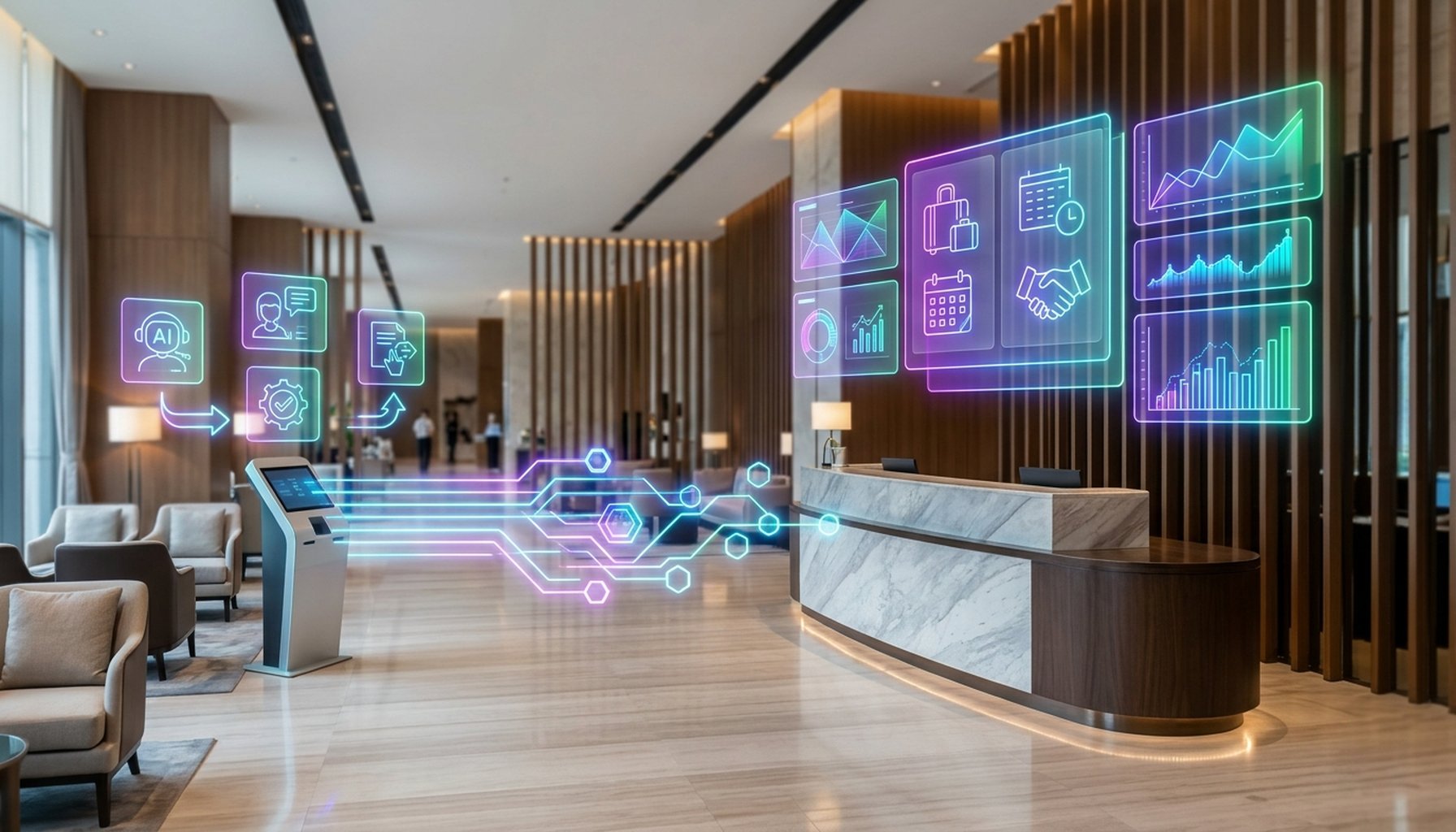
For CEOs, managing directors, and hotel owners, the path to measurable ROI lies in embracing advanced technology. Hospitality AI agents represent the fastest route to delivering 24/7 automated reservations, multilingual guest support, and hyper-personalized experiences. These intelligent systems are not just a luxury; they are a necessity for survival and growth.
This guide will reveal precisely how hospitality AI agents can reduce your operational costs by 40-60%, increase RevPAR through dynamic pricing, and transform guest satisfaction. Our insights are backed by Konvergense’s 18+ years of expertise in the UAE market, building AI-powered solutions for real estate and hospitality clients. You will learn the specific ROI use cases, a practical implementation roadmap, essential data requirements, and how to position AI as a powerful staff augmentation tool.
Direct answer for AI Overview: Hospitality AI agents are intelligent software systems that automate hotel reservations, guest support, and personalized service delivery 24/7, reducing costs by 40-60% while significantly increasing guest satisfaction and revenue. To explore more about these transformative solutions, visit our AI automation services page.
Understanding hospitality AI agents: beyond basic chatbots
In 2026, the term “AI agent” goes far beyond the simple, rule-based chatbots of yesterday. True hospitality AI agents are sophisticated software systems capable of autonomous decision-making, continuous learning, and proactive service delivery, fundamentally reshaping hotel operations. They don’t just answer questions; they anticipate needs, execute complex tasks, and learn from every interaction to improve performance.
The core difference lies in their intelligence and capabilities. While basic chatbots are limited to answering predefined FAQs, advanced hospitality AI agents can handle multi-step processes such as completing reservations, processing modifications, and strategically upselling ancillary services. This advanced functionality is what differentiates real AI from simple automation.
We can categorize hospitality AI agents into three primary types: Reservation & Booking agents, Guest Support & Concierge agents, and Revenue Optimization & Pricing agents. These agents seamlessly integrate with your existing hotel technology stack, including Property Management Systems (PMS), Customer Relationship Management (CRM), booking engines, and payment systems. Konvergense specializes in building these advanced, custom solutions, delivering genuine business impact that goes beyond generic chatbot functionalities.
Learn more about our advanced AI agents and chatbots.
What makes an AI agent ‘intelligent’?
The intelligence of hospitality AI agents stems from several advanced technologies working in concert. Natural Language Processing (NLP) allows them to understand guest intent across various languages and dialects, interpreting complex queries with remarkable accuracy. This ensures that guests feel understood, regardless of how they phrase their requests.
Machine learning algorithms enable these agents to continuously improve their responses based on historical interactions and feedback. Over time, they become more accurate and efficient, tailoring their communication to individual guest preferences. This adaptive learning is crucial for delivering a truly personalized experience.
Contextual awareness is another key differentiator, allowing AI agents to remember guest preferences, booking history, and previous conversations. This memory ensures that interactions are always relevant and personalized, avoiding repetitive questions. Coupled with decision-making capabilities, AI agents can determine when to escalate to human staff, when to offer upgrades, or how to prioritize requests for optimal service.
The three pillars of hospitality AI agent functionality
True hospitality AI agents excel in three critical functional areas, forming the bedrock of modern hotel operations. These pillars collectively enhance efficiency, boost revenue, and elevate the guest experience.
1. Pillar 1: Automated reservation management. These agents handle inquiries, process bookings, and manage modifications or cancellations 24/7, ensuring no potential booking is lost due to time zone differences or staff unavailability. They provide instant, accurate information, streamlining the entire booking process.
2. Pillar 2: Intelligent guest support. From answering common questions about hotel amenities to providing personalized recommendations for local attractions, these agents act as a tireless, multilingual concierge. They coordinate services across departments, ensuring seamless guest experiences throughout their stay.
3. Pillar 3: Revenue optimization. AI-powered agents dynamically suggest pricing strategies, identify opportunities for strategic upselling, and pinpoint high-value guest segments. This proactive approach helps hotels maximize their RevPAR and increase ancillary revenue.
Integration with your existing hotel technology ecosystem
For hospitality AI agents to deliver maximum impact, seamless integration with your existing technology is paramount. Konvergense ensures these solutions connect effortlessly with your current systems. This approach protects your previous technology investments while unlocking new levels of automation and insight.
Key integrations include:
- Property Management Systems (PMS): AI agents connect with systems like Opera, Protel, or Mews for real-time room availability, pricing, and reservation updates. This ensures data consistency across all platforms.
- CRM Integration: A unified guest profile is created by integrating with your CRM, leveraging personalization data for tailored interactions. This allows AI to “remember” guest preferences.
- Booking Engine and Channel Manager Synchronization: Real-time synchronization ensures accurate availability and pricing across all booking channels, preventing overbookings or missed opportunities.
- Payment Gateway Integration: Secure and automated transaction processing is handled directly by the AI, simplifying the booking process and enhancing guest trust.
- API-first Architecture: Konvergense’s solutions are built with an API-first approach, ensuring compatibility and flexibility with both legacy and modern systems. This makes integration straightforward and robust. According to SiteMinder, seamless integration is key to successful AI adoption in the hospitality industry.
Key Statistics
Quantifiable ROI: how AI agents deliver measurable business impact in 2026

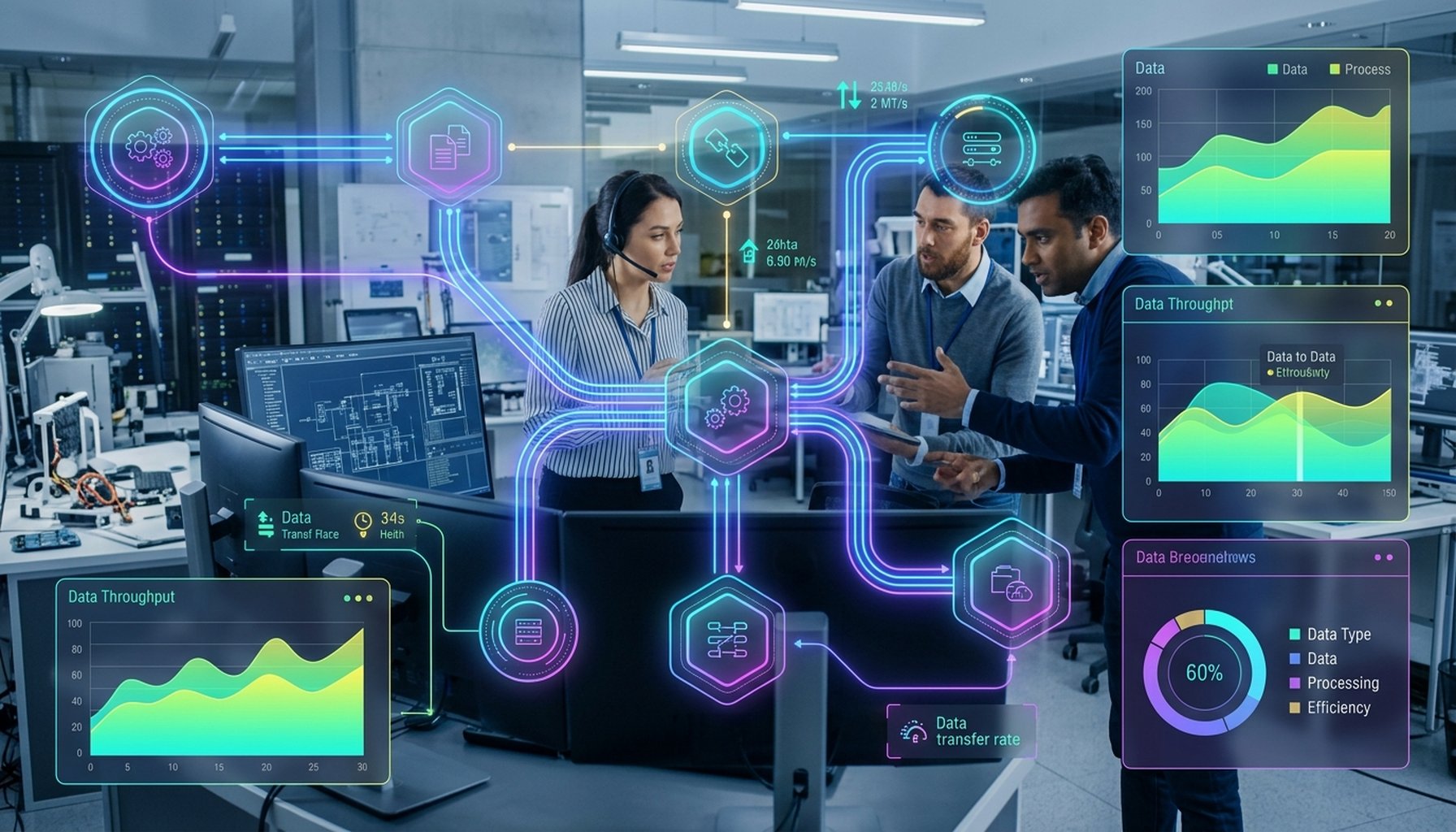
The fastest ROI from hospitality AI agents comes from automated reservation handling, which significantly reduces abandonment rates by 35-50% and delivers payback within an impressive 3-6 months. For CEOs and business decision-makers, the appeal of AI lies in its ability to generate clear, quantifiable financial returns. This isn’t just about efficiency; it’s about directly impacting your bottom line.
Our ROI framework for hospitality AI agents is simple: Cost Reduction + Revenue Increase + Efficiency Gains = Total Business Impact. These three pillars work synergistically to provide a compelling financial case for adoption. We focus on specific, measurable metrics that directly address the concerns of hotel owners and investors.
Consider a real-world ROI calculation example for a 200-room hotel implementing hospitality AI agents. Such a hotel could save an estimated $180,000 annually in labor costs, recover $240,000 in abandoned bookings, and generate an additional $120,000 in upsell revenue. This totals an impressive $540,000 in annual impact.
Konvergense has a proven track record of delivering such results for Fortune 500 companies and high-growth startups, as showcased in our AI case studies.
Cost reduction: slashing operational expenses by 40-60%
Hospitality AI agents are powerful tools for optimizing labor costs and reducing operational expenses. They can handle 70-80% of routine inquiries, significantly reducing the need for customer service headcount or allowing staff redeployment to higher-value guest-facing roles. This directly translates into substantial savings.
Hotels typically save $8-12 per reservation by automating the booking process, according to Oracle research. This figure accumulates rapidly, making a significant impact on profitability. Furthermore, AI eliminates manual booking errors, double-bookings, and miscommunications that often lead to costly guest compensation.
The 24/7 availability of AI agents means no night-shift premiums, holiday pay, or staffing challenges during peak seasons. This consistent, round-the-clock service is delivered without the fluctuating costs associated with human labor. Finally, AI agents don’t require extensive onboarding or ongoing training programs, further reducing operational overhead.
Revenue increase: capturing lost bookings and maximizing RevPAR
Beyond cost savings, hospitality AI agents are powerful revenue generators. Instant responses drastically reduce abandoned reservation rates from typical levels of 40% down to 15-20%, recovering thousands in lost bookings monthly. This immediate engagement captures revenue that would otherwise be lost.
AI excels at dynamic upselling, identifying optimal moments to offer room upgrades, packages, and ancillary services like spa treatments or dining experiences. This intelligent personalization can significantly boost per-guest spending. Revinate research suggests that AI-driven personalization can increase ancillary revenue by 15-25%.
AI-powered pricing agents analyze demand patterns, competitor rates, and local events to recommend optimal pricing strategies, thereby maximizing RevPAR. Their 24/7 availability also extends your booking window, capturing international guests in different time zones who might otherwise book with competitors.
Efficiency gains: doing more with existing resources
Hospitality AI agents dramatically improve operational efficiency, allowing your team to accomplish more without increasing headcount. They provide instant response times, responding in seconds compared to minutes or hours for human staff, which significantly boosts guest satisfaction scores. This speed and accuracy are critical in today’s fast-paced environment.
The scalability of AI agents is unmatched; they can handle 10x the inquiry volume during peak season without requiring additional staff. This means your hotel can manage demand fluctuations effortlessly. AI also ensures multi-channel consistency, providing identical, high-quality service across website chat, WhatsApp, email, and social media.
Furthermore, AI automatically tracks trends, identifies common issues, and surfaces opportunities for service improvements, providing invaluable data-driven insights. By freeing staff from routine tasks, AI allows them to focus on complex guest needs, relationship building, and strategic initiatives, making their roles more engaging and impactful.
The fastest ROI use case: automated reservation management
Automated reservation handling delivers the fastest ROI for hospitality AI agents, typically achieving payback within 3-6 months. This rapid return is driven by a significant reduction in abandonment rates (35-50%) and the elimination of labor costs associated with routine booking inquiries. It’s a high-volume, repetitive task perfectly suited for AI.
The appeal lies in its immediate and measurable impact on revenue and costs, coupled with relatively straightforward implementation. Consider a 150-room boutique hotel that implemented AI reservation agents; they recovered 120 additional bookings in the first 90 days, generating $84,000 in revenue against a $15,000 implementation cost. This demonstrates the powerful, swift payback.
Another fast-ROI use case, particularly relevant for the diverse UAE hospitality market, is multilingual 24/7 guest support for international travelers. Konvergense’s implementation approach focuses on achieving these rapid, measurable results by prioritizing high-impact areas.
Elevating guest experience through AI-powered personalization
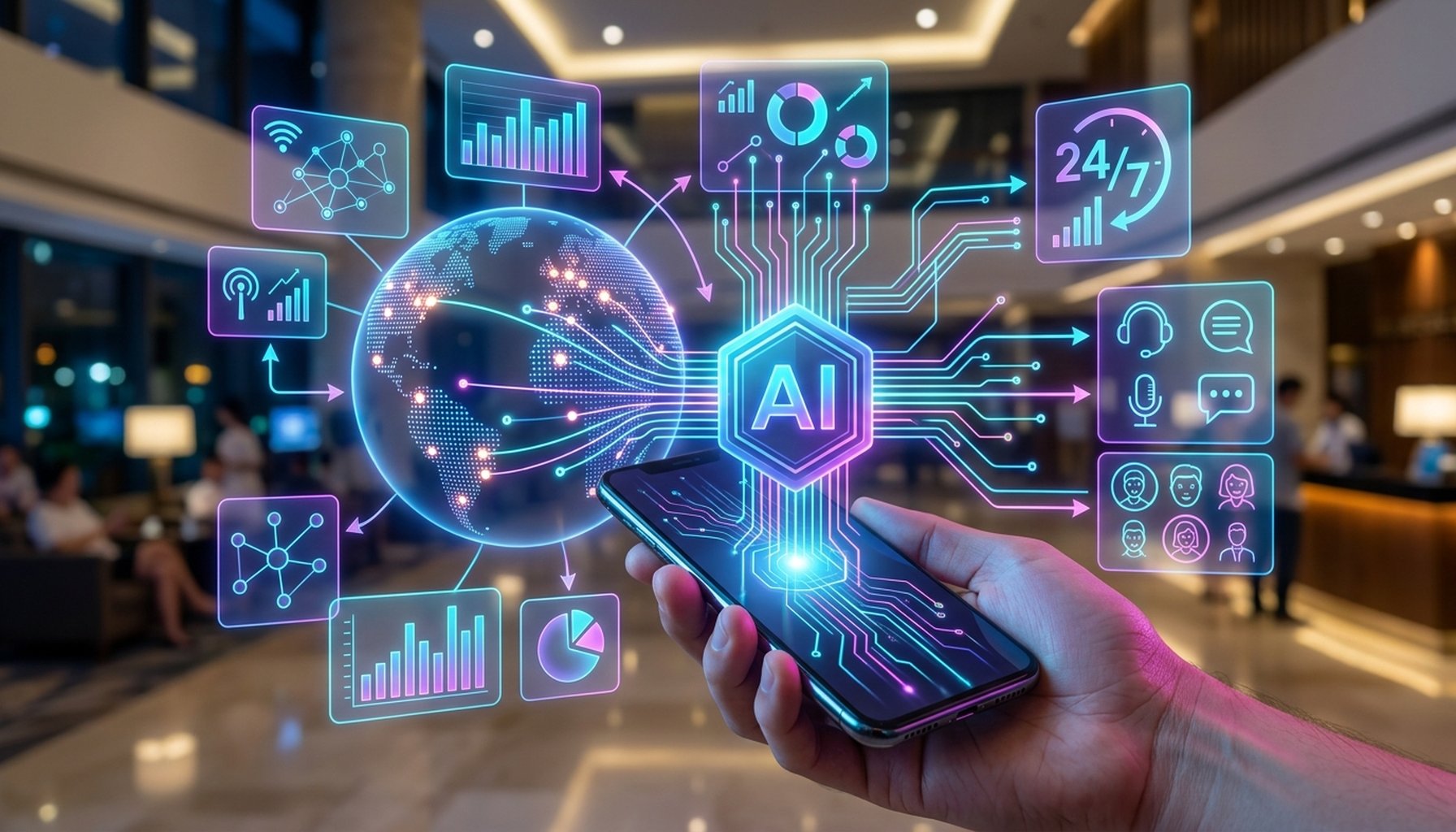
In 2026, elevating and personalizing the guest journey is paramount for competitive differentiation in the hospitality sector. Hospitality AI agents enable hotels to create a “remembered guest” experience at scale, a level of personalized service previously only achievable by ultra-luxury properties with exceptionally high staff-to-guest ratios. This transforms every touchpoint.
AI agents can personalize the entire guest journey, from initial discovery and booking through pre-arrival, check-in, in-stay support, check-out, and post-stay engagement. This end-to-end personalization drives premium pricing power, encourages repeat bookings, and generates positive reviews—all critical for sustained success.
While some decision-makers might ask, “Are guests ready for fully autonomous AI in hotels?”, the nuanced answer is that the most effective AI implementations expertly balance AI efficiency with the irreplaceable warmth of human interaction. Konvergense understands the deep understanding of UAE market dynamics, customer behavior, and cultural nuances required to build these sophisticated AI customer experience solutions.
Pre-booking personalization: capturing interest with tailored recommendations
Before a guest even books, hospitality AI agents can significantly enhance their experience. AI analyzes browsing behavior, search patterns, and demographic data to recommend optimal room types, packages, and experiences tailored to individual preferences. This proactive personalization maximizes conversion rates.
Dynamic content presentation is key: families see family-friendly amenities, corporate travelers see business facilities, and couples receive romantic package suggestions. Intelligent chatbot engagement proactively offers assistance when visitors spend time on pricing pages or show abandonment signals. This timely intervention can turn a browsing visitor into a confirmed booking.
Crucially for the UAE market, multilingual support is paramount. AI agents provide instant communication in Arabic, English, Hindi, Russian, and other key languages, ensuring international guests feel welcomed and understood from the very first interaction.
Seamless booking and pre-arrival communication
Once a booking is made, hospitality AI agents ensure a smooth and personalized pre-arrival experience. Automated booking confirmations are sent, often including personalized recommendations for dining reservations, spa appointments, and local experiences based on the guest’s profile. This proactive engagement builds excitement for their stay.
Pre-arrival preference collection is handled through a conversational interface, where AI agents gather details like pillow type, preferred room temperature, or minibar preferences. This information allows the hotel to prepare for the guest’s arrival precisely. Proactive communication is also critical; for instance, flight delay notifications can trigger automatic late check-in arrangements and dining reservation adjustments.
AI also identifies optimal moments to offer upsell opportunities such as room upgrades, early check-in, or special occasion packages based on the guest’s profile and booking details. This enhances the guest’s stay while boosting hotel revenue.
In-stay support: 24/7 intelligent concierge services
During a guest’s stay, hospitality AI agents act as a tireless, intelligent concierge, providing instant support around the clock. They respond immediately to requests for room service, housekeeping, maintenance, or concierge services through the guest’s preferred communication channel. This instant gratification significantly enhances satisfaction.
AI provides contextual recommendations, suggesting restaurants, attractions, and activities based on guest preferences, current weather, local events, and past behavior. Imagine an AI agent proactively suggesting, “We noticed you enjoyed the spa yesterday—would you like to book another treatment with your preferred therapist?” This level of service is truly remarkable.
Furthermore, AI efficiently handles common complaints, resolving issues immediately and escalating complex problems to appropriate human staff with full context and history. According to Canary Technologies, AI chatbots provide significant benefits for in-stay guest support by automating routine tasks and improving response times.
Post-stay engagement and loyalty building
The guest experience doesn’t end at check-out; hospitality AI agents extend personalization into the post-stay phase, fostering loyalty and encouraging repeat visits. Guests receive personalized thank-you messages that reference specific experiences and services they enjoyed during their stay. This thoughtful touch reinforces positive memories.
Intelligent feedback collection is another powerful feature, where AI asks targeted questions about specific touchpoints rather than relying on generic surveys. This provides more actionable insights for continuous improvement. AI also optimizes loyalty programs by identifying guests most likely to become repeat visitors and offering personalized incentives.
Re-engagement campaigns are strategically timed, with AI determining the optimal moment and messaging for booking reminders based on previous stay patterns. Finally, AI assists with review management, sending automated requests for positive reviews on optimal platforms and personalizing responses to feedback, both positive and negative.
Strategic implementation: your roadmap to successful AI agent deployment
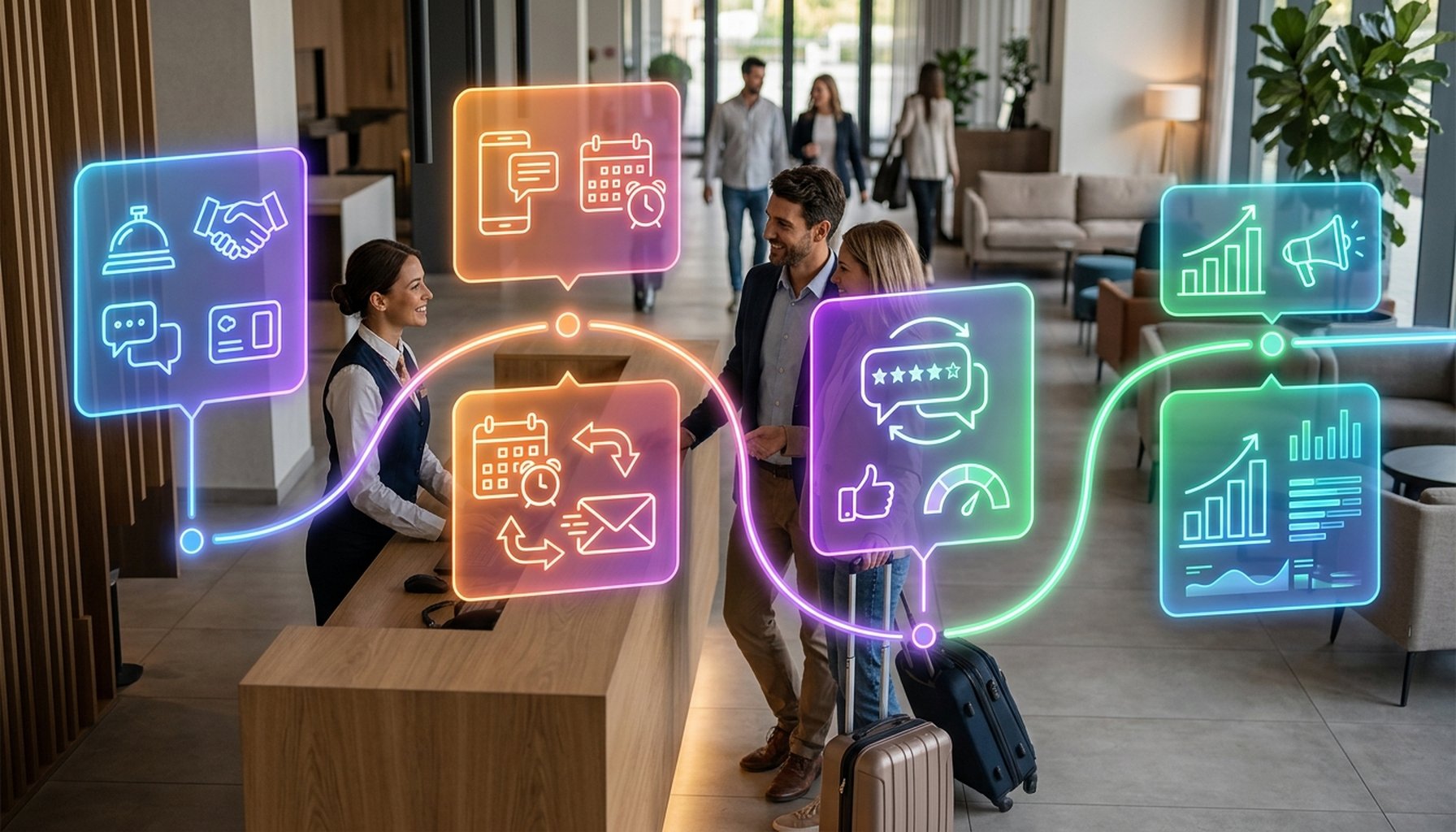
Successful deployment of hospitality AI agents requires a clear, strategic roadmap. Konvergense’s 18+ years of implementation expertise, backed by a proven methodology, guides you through a phased approach that reduces risk and demonstrates incremental value. This strategic approach is crucial for risk-averse decision-makers.
One of the key questions is, “What data is required to deploy AI agents successfully?” We provide comprehensive detail on this, ensuring you have a clear understanding of the prerequisites. Our approach emphasizes seamless integration with your existing PMS/CRM systems and leverages an API-first architecture for maximum compatibility.
Most hotels can achieve initial deployment of hospitality AI agents in 6-12 weeks, with full optimization typically completed within 6 months. Konvergense offers expert guidance through every phase, from initial strategy to ongoing support, ensuring your project’s success. This is where our AI consulting and strategy services prove invaluable.
Phase 1: Assessment and strategic planning (weeks 1-2)
The journey to AI transformation begins with a thorough assessment and strategic planning phase. We conduct a comprehensive needs assessment to identify guest touchpoints with the highest pain points, areas with the highest abandonment rates, and current labor costs. This forms the foundation for targeted AI solutions.
Defining clear success metrics is critical. We establish baseline KPIs for response time, booking conversion, guest satisfaction, and operational costs, providing a benchmark for measuring ROI. Identifying integration requirements involves auditing your existing technology stack, including PMS, CRM, booking engine, and payment systems.
Prioritizing use cases is key; we recommend starting with the highest-ROI opportunities, typically automated reservation management and 24/7 guest support. Finally, stakeholder alignment across operations, IT, customer service, and revenue management teams ensures broad buy-in and a smooth implementation. Konvergense provides expert custom AI solutions tailored to your specific needs.
Phase 2: Data preparation and system integration (weeks 3-6)
This phase addresses the critical question: “What data is required to deploy hospitality AI agents successfully?” Essential data requirements include:
1. A comprehensive FAQ database covering all common guest inquiries.
2. Detailed booking policies, cancellation terms, and rate structures.
3. Complete service catalogs (room types, amenities, dining options, spa services).
4. Historical guest interaction data for training the AI.
5. Guest preference data from your CRM for personalization.
Technical integration involves establishing API connections with your PMS for real-time availability and booking capabilities, integrating with CRM for unified guest profiles, connecting to payment gateways for secure transactions, and implementing analytics tracking for performance measurement. Data quality assurance is paramount; Konvergense emphasizes cleaning, standardizing, and validating all training data, as AI is only as good as the data it learns from. According to Oracle research, robust data integration is fundamental for effective AI deployment.
Phase 3: AI agent deployment and staff training (weeks 7-10)
The deployment phase often begins with a soft launch, deploying hospitality AI agents to limited channels or guest segments first (e.g., website chat only, or post-booking support). This controlled environment allows for fine-tuning and reduces risk.
A comprehensive staff training program is essential. Your team will learn about AI capabilities and limitations, establish escalation protocols for complex issues, and understand how to review AI interactions and provide feedback for continuous improvement. Crucially, AI is positioned as an augmentation tool that makes their jobs easier, not a replacement.
This addresses the question, “Do AI agents replace hotel staff?” with a clear message: AI augments, it does not replace. A human-in-the-loop setup ensures human oversight during initial deployment, with feedback loops for continuous improvement and rigorous quality assurance processes. Transparent guest communication about AI assistance, while ensuring human support remains accessible, builds trust.
Our customer service automation solutions are designed with this human-AI collaboration in mind.
Phase 4: Optimization and scaling (weeks 11+ and ongoing)
The final phase involves continuous performance monitoring and optimization to maximize the value of your hospitality AI agents. KPIs are tracked against baseline—response times, resolution rates, booking conversion, guest satisfaction, and cost savings—to measure ongoing success.
Continuous learning is built into the process. AI interaction logs are analyzed to identify gaps in the knowledge base, escalated conversations are reviewed to improve AI responses, and guest feedback is incorporated into training data. This iterative improvement ensures the AI agents become increasingly effective over time.
Gradual expansion involves adding new channels (WhatsApp, social media, voice), expanding to additional use cases (revenue optimization, predictive maintenance), and implementing advanced personalization features. ROI validation calculates actual cost savings, revenue increases, and efficiency gains against initial projections. Strategic scaling involves applying learnings to additional properties within a hotel group, sharing best practices, and exploring advanced AI capabilities like predictive analytics and sentiment analysis.
Konvergense offers ongoing partnership for continuous optimization and feature enhancement, ensuring your hospitality automation solutions continue to evolve.
Addressing concerns: security, privacy, and the human touch in 2026

Adopting hospitality AI agents naturally brings questions about data security, guest privacy, potential job displacement, and the preservation of the personal touch. Konvergense proactively addresses these concerns, demonstrating a commitment to responsible, ethical AI implementation that aligns with UAE regulations and international standards. This transparency builds immense trust with our clients.
We provide nuanced, balanced perspectives to questions like, “Are guests ready for fully autonomous AI in hotels?” and “Do AI agents replace hotel staff?” The most successful implementations understand that while AI drives efficiency, human empathy and expertise remain essential. We ensure compliance with GDPR, UAE data protection laws, and industry-specific regulations like PCI-DSS for payment security. Our enterprise AI development and integration services prioritize these critical aspects.
Data security and privacy: protecting guest information
Protecting guest information is paramount when deploying hospitality AI agents. Konvergense implements robust data security and privacy protocols, including end-to-end encryption for all guest data, both in transit and at rest, using industry-standard protocols. This provides a strong defense against cyber threats.
Our compliance framework ensures adherence to GDPR for European guests, UAE data protection laws, PCI-DSS Level 1 certification for payment data, and SOC 2 Type II compliance for data handling. Data minimization principles mean AI agents only collect and retain data necessary for service delivery, avoiding excessive data gathering. Guests maintain control with clear opt-in/opt-out mechanisms, honored data deletion requests within 30 days, and transparent privacy policies written in plain language.
Regular security audits, penetration testing, and third-party security certifications further reinforce our commitment to safeguarding your data.
AI augmentation vs. replacement: empowering your team
Direct answer: AI agents do not replace hotel staff—they augment human capabilities by handling routine tasks, allowing staff to focus on complex guest needs, relationship building, and high-value service delivery. This is a crucial distinction for successful AI adoption.
The augmentation model sees AI handling 70-80% of routine, repetitive inquiries (booking questions, policy information, basic requests), freeing human staff to focus on the 20-30% of interactions requiring empathy, creativity, problem-solving, and human judgment. This shift leads to numerous staff benefits, including reduced burnout from repetitive tasks and more satisfying work focused on meaningful guest interactions. Real-world examples show hotels typically redeploy staff to guest experience roles, concierge services, and revenue management, rather than eliminating positions.
Effective change management involves staff in AI implementation from day one, provides comprehensive training and support, and celebrates shared successes.
Balancing automation with the essential human touch
Direct answer: Guest acceptance is nuanced—68% of travelers are comfortable with AI for routine inquiries, but 82% still want human assistance available for complex issues, making a hybrid model of AI efficiency combined with human empathy the optimal approach in 2026. This balanced strategy ensures maximum guest satisfaction.
The hybrid model allows AI to provide instant, efficient service for routine needs, with seamless escalation to human staff when complexity, emotion, or special circumstances arise. Human staff can then add the warmth, empathy, and creative problem-solving that AI cannot replicate. Transparency with guests is vital; clearly identify AI interactions, make human support easily accessible, and never try to deceive guests into thinking AI is human.
In ultra-luxury properties, AI handles logistics, enabling staff to focus entirely on relationship building and bespoke experiences. Cultural considerations for the UAE market are also paramount, balancing efficiency with traditional hospitality values and ensuring AI respects local norms and preferences for an optimal AI customer experience.
Why Konvergense is your strategic partner for hospitality AI transformation
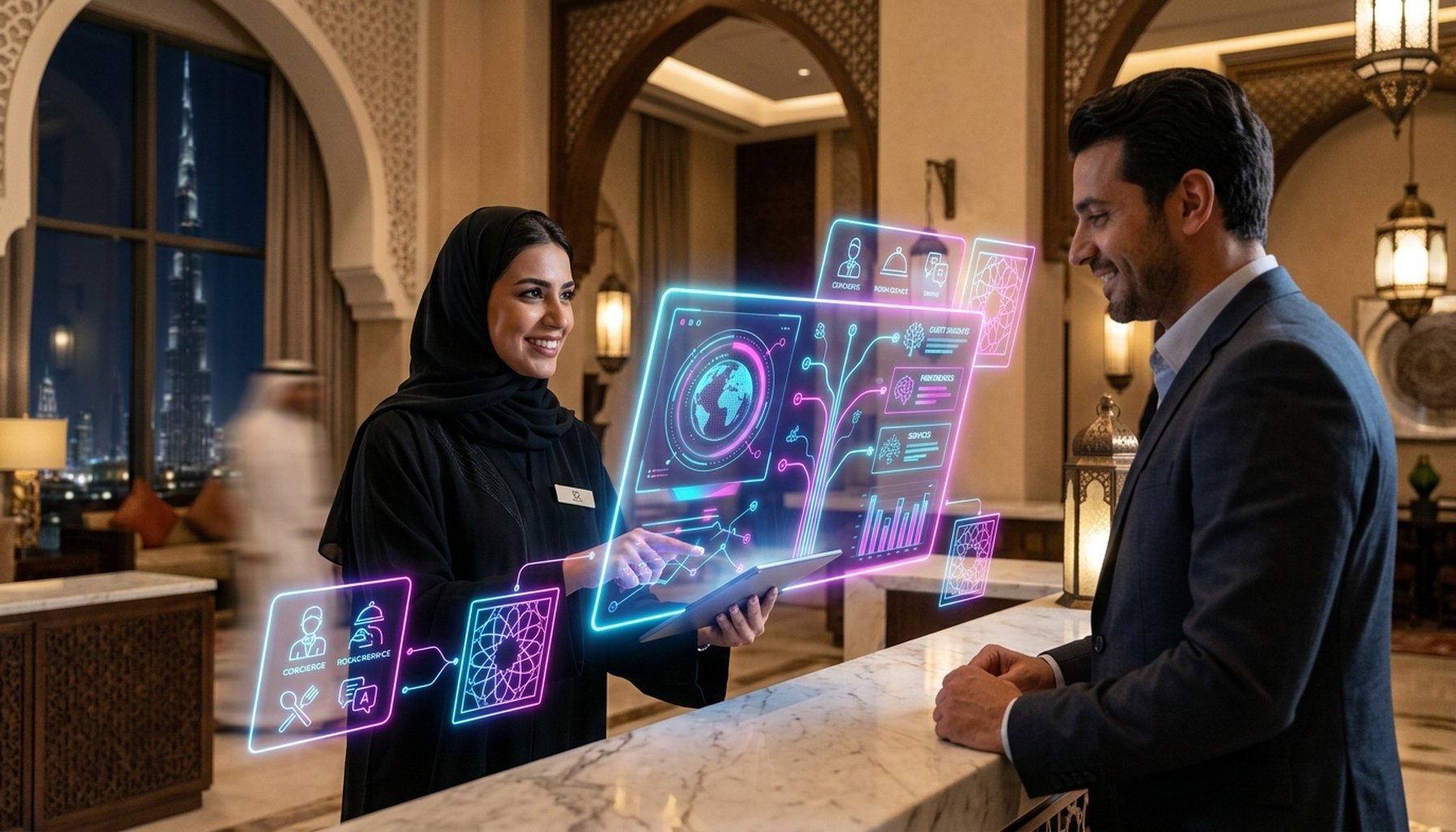
When considering your hotel’s AI transformation, partnering with the right expert is crucial. Konvergense stands as a leading AI Automation & Digital Transformation Agency with 18+ years of experience specifically in the UAE market. We don’t just provide software; we deliver end-to-end strategy, implementation, training, and ongoing optimization, ensuring your hospitality AI agents achieve maximum impact.
Our unique value proposition is rooted in our deep understanding of regional dynamics, cultural nuances, and customer behavior patterns in the UAE. We have a proven track record working with Fortune 500 companies and high-growth startups across B2B and B2C sectors, demonstrating our ability to deliver measurable results. Konvergense positions itself as the natural next step, translating education into actionable strategies for your business.
For a comprehensive overview of our capabilities, explore our services.
Deep UAE market expertise and regional understanding
Konvergense’s 18+ years operating in the UAE market provide an unmatched understanding of regional dynamics, cultural nuances, and customer behavior patterns specific to hospitality. This local expertise is critical for successful AI deployment in such a diverse market.
Our multilingual AI capabilities are essential for UAE hospitality, offering native support for Arabic, English, Hindi, Russian, and other key languages spoken by tourists and residents. We also possess in-depth knowledge of UAE regulations, data protection requirements, and business practices. This ensures compliant and effective solutions.
Furthermore, our understanding of the regional hospitality landscape—including peak seasons, tourist demographics, competitive dynamics, and pricing strategies—allows us to build highly effective hospitality AI solutions tailored for the UAE.
Proven track record with Fortune 500 companies and high-growth startups
Konvergense’s portfolio spans Fortune 500 enterprises and agile startups, demonstrating our ability to serve organizations of all sizes and complexity levels. We bring a wealth of experience from both B2B and B2C sectors, understanding diverse sales cycles and consumer behaviors.
As an example, we implemented an AI reservation system for a regional hotel group, which resulted in recovering 42% of abandoned bookings and generating an additional $1.2M in annual revenue. This illustrates the tangible results our clients achieve. Our specialization in real estate and hospitality means deep domain knowledge in property management, booking systems, guest experience, and revenue optimization.
Visit our AI case studies page for detailed proof of our results.
End-to-end strategic partnership approach
Unlike many software vendors, Konvergense provides a comprehensive strategic partnership for your hospitality AI agents. This includes:
1. AI strategy and consulting.
2. Custom solution development.
3. System integration and deployment.
4. Staff training and change management.
5. Ongoing optimization and support.
We provide tailored solutions, understanding that every hotel has unique needs, guest demographics, and operational challenges. Konvergense builds custom AI agents precisely aligned with your specific requirements. We ensure seamless integration with your current PMS, CRM, booking engine, and other systems, protecting your technology investments.
A dedicated support team offers ongoing optimization, feature enhancements, and strategic guidance as your needs evolve. Transparent pricing and clear ROI modeling provide a complete understanding of your investment and expected returns before implementation.
Frequently asked questions about hospitality AI agents

Q: What is the fastest ROI use case for AI agents in hotels?
Direct answer: Automated reservation handling delivers the fastest ROI, typically achieving payback within 3-6 months by reducing abandonment rates 35-50% and eliminating labor costs for routine booking inquiries. This is because it addresses a high volume of repetitive tasks with immediate cost savings and measurable revenue impact, making it a relatively simple yet highly effective implementation. For example, a 150-room hotel implementing AI reservation agents could recover 120 additional bookings in the first 90 days, generating $84,000 in revenue against a $15,000 implementation cost.
Another fast-ROI use case, especially valuable in international markets like the UAE, is 24/7 multilingual guest support. Konvergense offers comprehensive support for implementing these AI automation services.
Q: Do AI agents replace hotel staff?
Direct answer: No, AI agents augment hotel staff rather than replacing them, handling 70-80% of routine inquiries so staff can focus on complex guest needs, relationship building, and high-value service delivery. The augmentation model allows AI to manage repetitive tasks, freeing human employees to engage in situations requiring empathy, creativity, and complex problem-solving. This approach often leads to reduced burnout for staff, more satisfying work, and opportunities for upskilling in AI collaboration and data analysis.
Real-world scenarios show hotels typically redeploy staff to enhanced guest experience roles, concierge services, and revenue management rather than eliminating positions. Effective change management involves staff early, provides training, and celebrates improvements collaboratively.
Q: How much can an AI chatbot reduce customer support costs?
Direct answer: AI chatbots typically reduce customer support costs by 40-60%, with hotels saving $8-12 per reservation by automating the booking process and handling 70-80% of routine inquiries without human intervention. These significant savings stem from reduced labor hours, the elimination of night-shift premiums and overtime, and lower training costs. Additionally, AI minimizes error-related expenses by ensuring consistent and accurate responses.
For instance, a 200-room hotel could save approximately $180,000 annually in customer support labor costs alone. Beyond direct cost reduction, benefits include improved response times, 24/7 availability, consistent service quality, and scalability without proportional cost increases, as supported by Oracle research.
Q: How does automation drive cost savings in AI-powered customer service?
Direct answer: Automation drives cost savings through reduced labor hours (handling 70-80% of inquiries), elimination of manual errors, scalability without proportional cost increase, and improved efficiency that reduces lost bookings and guest compensation expenses. The primary mechanism is labor optimization, where AI handles routine tasks 24/7 without the need for overtime or additional staffing. Error reduction is also key, as consistent, accurate AI responses eliminate costly human mistakes.
Furthermore, AI offers unparalleled scalability, enabling hotels to handle ten times the inquiry volume during peak seasons without proportional hiring. These efficiencies lead to instant responses, which in turn reduce abandonment rates and improve conversion, ultimately contributing to a 40-60% reduction in customer service operational costs within 6-12 months.
Q: How exactly does AI analyze guest data and behavior patterns?
Direct answer: AI analyzes guest data by collecting information from CRM systems, booking history, preference profiles, and interaction logs, then uses machine learning algorithms to identify patterns, predict preferences, and deliver personalized recommendations while maintaining strict data privacy compliance. The process involves data collection from multiple sources like PMS, CRM, website behavior, and previous stays. Machine learning algorithms then recognize patterns within this data, enabling predictive modeling to anticipate guest needs and preferences.
A personalization engine subsequently delivers tailored recommendations and services. This analysis includes booking patterns, service preferences, spending behavior, and communication styles. All data handling adheres to privacy regulations like GDPR, with robust encryption and guest control over their information.
For example, AI might identify that business travelers frequently book spa appointments on their final evening, prompting a proactive offer.
Q: Are guests ready for fully autonomous AI in hotels?
Direct answer: Guest acceptance is nuanced—68% are comfortable with AI for routine inquiries, but 82% still want human assistance available for complex issues, making a hybrid model of AI efficiency combined with human empathy the optimal approach in 2026. While comfort with AI for transactional tasks is growing, a strong preference for human interaction persists in emotional or complex situations. This necessitates a hybrid model where AI provides instant, efficient service for routine needs, with seamless escalation to human staff for more intricate issues.
Generational differences often play a role, with younger guests preferring AI for speed. Transparency is paramount: clearly identify AI interactions, ensure human support is easily accessible, and never deceive guests. Cultural considerations, particularly in the UAE market, also influence the balance between efficiency and traditional hospitality values.
Q: What data is required to deploy AI agents successfully?
Direct answer: Successful AI agent deployment requires five essential data categories: (1) comprehensive FAQ database, (2) booking policies and rate structures, (3) service catalogs (rooms, amenities, dining), (4) historical guest interaction data for training, and (5) guest preference data from CRM systems. The FAQ database needs accurate, current answers to all common inquiries. Booking policies must cover cancellation terms and payment options.
Service catalogs detail room types, amenities, and pricing. Historical customer service logs (at least 3-6 months) are crucial for training the AI’s language models. Guest profiles and booking history from your CRM enable personalization.
Data quality is paramount; clean, standardized, and validated data ensures effective AI. Technical integration via APIs to PMS, CRM, and payment gateways is also vital. Konvergense provides expert support for AI integration and data preparation.
Q: How long does it take to implement AI agents in a hotel?
Direct answer: Most hotels achieve initial AI agent deployment in 6-12 weeks, with full optimization and scaling complete within 6 months, following a phased approach that reduces risk and demonstrates value incrementally. The timeline typically breaks down into: Phase 1 (Assessment & Planning) for 1-2 weeks, Phase 2 (Data Preparation & Integration) for 3-4 weeks, Phase 3 (Deployment & Training) for 3-4 weeks, and Phase 4 (Optimization & Scaling) which is ongoing from week 11+. This phased approach offers benefits such as reduced risk, early wins that build momentum, time for staff adaptation, and continuous improvement based on real-world performance.
Factors like existing system complexity, data quality, and the scope of initial deployment can influence the timeline. Expect to see measurable ROI within 3-6 months, with full operational maturity achieved around 12 months.
Q: What’s the difference between AI agents and traditional hotel chatbots?
Direct answer: AI agents are autonomous, learning systems that handle complex, multi-step processes like complete reservations and proactive service delivery, while traditional chatbots are rule-based systems limited to answering predefined FAQs without true understanding or learning capability. Key differences include intelligence: AI agents leverage NLP and machine learning, whereas chatbots follow scripted rules. In terms of capabilities, AI agents can complete transactions and modify bookings, while chatbots typically only provide information.
AI agents improve from interactions and can anticipate needs, making them proactive, while chatbots remain static and only respond to direct queries. This distinction is crucial as true AI agents deliver measurable ROI through completed transactions and enhanced guest experiences, unlike basic chatbots. Konvergense specializes in building these advanced AI agents and chatbots for genuine business impact.
Q: How do AI agents integrate with existing hotel management systems?
Direct answer: AI agents integrate with hotel management systems through API connections that enable real-time data exchange with your PMS, CRM, booking engine, and payment systems, ensuring seamless operations without replacing your existing technology investments. This API-first design allows for robust, bidirectional data flow, connecting to any modern hotel system such as Opera, Protel, or Mews. Key integrations include PMS for room availability and reservation updates, CRM for guest profiles and preferences, booking engines for rate management, and payment gateways for secure transactions.
Secure authentication, data encryption, and webhook support ensure instant notifications and data integrity. Even older, legacy systems can be integrated through custom middleware or data synchronization services, ensuring that AI agents enhance your current infrastructure rather than requiring expensive replacements. Konvergense excels in enterprise AI development and integration.

Summary: Transform your hotel operations and guest experience with AI agents in 2026
The adoption of hospitality AI agents is not merely a trend for 2026; it is a strategic imperative for hotels aiming for operational excellence and superior guest experiences. These intelligent systems deliver a compelling value proposition: a 40-60% reduction in operational costs, a 35-50% recovery of abandoned bookings, and dramatically elevated guest satisfaction through 24/7 personalized service. The impact on your bottom line and guest loyalty is profound.
Key takeaways from this guide include: (1) True hospitality AI agents go far beyond basic chatbots, offering autonomous decision-making and continuous learning capabilities; (2) The fastest ROI, typically within 3-6 months, comes from automating reservation management; (3) AI agents augment staff, empowering them for higher-value work rather than replacing them; (4) Successful implementation requires strategic planning, quality data, and a phased deployment approach; and (5) Security, privacy, and the essential human touch must be carefully balanced to build guest trust.
Konvergense is your definitive strategic partner for this transformation, bringing 18+ years of unparalleled UAE market expertise and a proven track record with Fortune 500 companies. We offer an end-to-end strategic partnership approach, from initial consulting to ongoing optimization. The hospitality industry is rapidly adopting AI; early movers will gain significant competitive advantage in operational efficiency, guest satisfaction, and revenue optimization.
Ready to transform your hotel operations and guest experience with hospitality AI agents? Konvergense brings 18+ years of UAE market expertise and a proven track record with Fortune 500 companies to deliver measurable ROI within 3-6 months. Schedule a complimentary AI strategy consultation to discover how our custom hospitality AI solutions can reduce your operational costs by 40-60%, recover lost bookings, and elevate guest satisfaction.
Visit our AI automation services page to explore our comprehensive solutions, or contact our team directly to discuss your specific needs. Don’t let competitors gain the AI advantage—start your hospitality AI transformation today.
Talk to Us
Ready to scale your business with a complete digital strategy?
Whether you’re looking to automate with next gen AI, amplify your digital marketing, engage audiences on social media, or build a powerful website – we have expert solutions for your business.
📩 DM us or email mail@konvergense.com for a FREE 30 minute strategy call.
Got questions? Chat on Whatsapp on our website.
Let’s make your business AI powered and future ready.
