


Introduction
Why 40% of AI projects fail while smart Dubai businesses achieve 30-50% efficiency gains
Here’s a sobering reality: 40% of AI projects are cancelled before delivering measurable ROI.
What separates success from failure? It’s not the technology – it’s the measurement, implementation strategy, and organizational readiness.
Agentic AI represents a fundamental shift from traditional automation. Unlike rigid rule-based systems, agentic AI systems make autonomous decisions, take actions, and adapt without constant human intervention.
This guide provides a proven 3-lens ROI measurement framework that captures 100% of AI value, transparent cost breakdowns for Dubai SMEs, a 90-day fast-track implementation blueprint with 85% production deployment success rate, and industry-specific transformation roadmaps.
With 18+ years of UAE experience, Konvergense has validated these frameworks through hundreds of implementations with Fortune 500 companies and high-growth startups.
Understanding agentic AI: What it delivers superior ROI compared to traditional automation
Before diving into ROI frameworks, let’s establish what agentic AI actually is – and why it matters for your bottom line.
Traditional automation is like a vending machine (input A always produces output B), generative AI is like a creative assistant (produces new content based on prompts), and agentic AI is like a skilled employee (understands goals, makes decisions, takes actions, learns from outcomes).
Agentic AI systems exhibit five key characteristics: goal-oriented behavior, autonomous decision-making within established parameters, environmental awareness and context understanding, adaptive learning from outcomes, and multi-step reasoning for complex scenarios.
Consider a practical Dubai business example: An agentic AI customer service system doesn’t just answer FAQs.
The ROI differential is substantial. Traditional automation delivers 15-25% efficiency gains in targeted processes.
The evolution from rule-based automation to intelligent agents
The timing is particularly favorable for Dubai businesses. Technology maturation means proven frameworks exist. Cloud infrastructure through Azure and AWS Middle East data centers ensures low-latency performance.
The cost curve has shifted dramatically. Early RPA implementations required expensive custom development, often costing AED 500K-1M for modest deployments.
Key capabilities that drive measurable business outcomes
Natural language understanding for Arabic and English customer interactions means your system comprehends intent, not just keywords.
Proactive actions based on pattern recognition enable identifying at-risk customers before they churn, recognizing buying signals before leads explicitly request information, and detecting anomalies in operations before they become problems.
Integration capabilities with existing Dubai business systems – Zoho, Salesforce, Property Finder, Bayut, WhatsApp Business, and local payment gateways – ensure agentic AI enhances your current technology stack.
Real-world Dubai business applications across industries
Real estate agencies using agentic lead qualification see 35-45% improvement in conversion rates within 4-6 months.
Retail businesses achieve 30-40% customer service cost reduction while improving satisfaction scores. Dynamic inventory optimization reduces stockouts by 25-35% and overstock by 20-30%.
Finance and banking applications deliver 50-60% time reduction in document processing. Fraud detection systems identify suspicious patterns with 90%+ accuracy while reducing false positives by 40-50%.
The 3-lens ROI measurement framework: How to calculate true agentic AI value for Dubai businesses
Here’s the critical problem: 50% of AI value is missed when companies only measure cost savings.
The solution is the 3-Lens ROI Framework that captures Efficiency (cost/time savings), Growth (revenue/customer impact), and Strategic (competitive/innovation) value.
The weighted formula: Total ROI = (Efficiency Gains × 40%) + (Growth Impact × 35%) + (Strategic Value × 25%).
Lens 1: Efficiency gains – measuring cost savings and productivity improvements
Efficiency metrics are the most straightforward to measure and typically the first to deliver visible results.
Dubai SME benchmarks: A 50-employee company typically achieves AED 200K-400K annual savings. A 200-employee company sees AED 800K-1.5M. A 500-employee company realizes AED 2M-4M.
The calculation methodology: (Current Process Cost – Automated Process Cost) × Annual Volume = Annual Efficiency Savings.

Consider a Dubai real estate agency with 100 agents spending 15 hours per week on lead qualification. Agentic AI for real estate reduces this to 3 hours per week.
If implementation cost was AED 600K and annual maintenance is AED 150K, the first-year net ROI is AED 8.64M – AED 750K = AED 7.89M (1,052% return).
Lens 2: Growth impact – quantifying revenue and customer experience improvements
Growth metrics often deliver larger absolute value than efficiency savings.
Why growth impact often exceeds efficiency savings: A 10% increase in customer conversion or 15% increase in customer retention can dwarf operational cost savings.
A Dubai retail company implements AI marketing automation for personalized customer experiences. Website conversion rate increases from 2.3% to 3.1% (0.8 percentage point gain).
Lens 3: Strategic value – assessing competitive positioning and innovation capacity
Strategic metrics are the hardest to quantify but often the most valuable long-term. Define these carefully: competitive advantage duration, time-to-market for new products/services, organizational agility, and innovation velocity.
Value market share movement at revenue impact – if AI capabilities help you win three major contracts worth AED 10M that you would have lost to competitors, that’s AED 10M strategic value.
A Dubai fintech company deploys agentic AI for compliance automation, reducing new product launch time from 8 months to 3 months.
Building your custom ROI dashboard: KPIs and tracking methodology
Track 12 core KPIs – 4 from each lens – monitored monthly and reported quarterly.
Dashboard structure should include three layers: executive summary (one-page) highlighting key wins, challenges, and strategic implications; detailed metrics providing drill-down capability; and trend analysis showing quarter-over-quarter and year-over-year comparisons.
True cost anatomy and investment planning for Dubai SMEs in 2026
The number one question from Dubai business leaders: “How much will this actually cost?”
The framework breaks costs into four categories: Technology costs (30% of initial investment, 25% of ongoing annual costs), Implementation costs (40% of initial investment), Enablement costs (15% of initial investment), and Operations costs (15% of annual TCO).
Size-based investment ranges for Dubai companies: A 50-employee company should budget AED 150K-300K initial implementation plus AED 40K-70K annually.
Technology costs: Licensing, infrastructure, and platform fees
AI platform licensing follows two models: SaaS models charge AED 5K-25K monthly depending on scale; Enterprise licenses cost AED 200K-800K annually for unlimited usage.
Cloud infrastructure for model hosting runs AED 3K-15K monthly. Azure and AWS Middle East data centers provide low-latency performance while meeting UAE data residency requirements.
Integration middleware requires AED 30K-100K one-time setup. Security and compliance tools are critical for Dubai businesses handling customer data. Budget AED 20K-60K annually.
Implementation costs: Integration, customization, and deployment services
Discovery and planning establishes the foundation. Budget AED 40K-80K for 3-4 weeks.
System integration connects agentic AI to existing CRM, ERP, marketing automation, and customer service platforms. Budget AED 80K-250K for 6-10 weeks.
Customization and training fine-tunes models for industry-specific terminology, Arabic language nuances, and Dubai market context. Budget AED 60K-180K for 4-8 weeks.
Testing and validation ensures accuracy, reliability, and compliance. Budget AED 30K-70K for 2-4 weeks.
Enablement costs: Training, change management, and organizational readiness
Executive and stakeholder training builds AI literacy. Budget AED 15K-35K for 2-3 half-day sessions.
End-user training provides hands-on workshops. Budget AED 25K-60K for 4-8 training sessions.
Change management programs address the human side of AI transformation. Budget AED 40K-100K for 3-6 months.

Why this matters: 60% of AI project failures are due to organizational resistance, not technical issues.
Ongoing operational costs: Maintenance, optimization, and scaling
Platform maintenance and updates keep systems current. Budget AED 10K-30K monthly.
Model monitoring and retraining ensures accuracy doesn’t degrade. Budget AED 8K-20K monthly.
Support and troubleshooting provides dedicated assistance. Budget AED 5K-15K monthly.
90-day fast-track implementation blueprint: From pilot to production with measurable ROI
Most AI implementations take 12-18 months, leading to stakeholder fatigue, budget overruns, and project cancellations.
Konvergense’s proven alternative is the 90-Day Fast-Track Blueprint that delivers measurable ROI within one quarter.
The framework divides implementation into three 30-day phases: Discovery and Pilot Design (Days 1-30), Deployment and Quick Wins (Days 31-60), and Measurement and Scaling Decisions (Days 61-90).
Phase 1 (Days 1-30): High-impact use case identification and pilot design
Week 1-2 focuses on business process audit and pain point identification. Map current workflows with actual time and cost data.
Week 2-3 prioritizes use cases using an ROI potential matrix. Score each opportunity on impact and implementation complexity.
Week 3-4 defines pilot scope and success criteria. Select 1-2 high-impact, moderate-complexity use cases for a focused 30-day pilot.
Phase 2 (Days 31-60): Pilot deployment and quick win validation
Week 5-6 executes rapid prototyping and configuration using pre-built components and templates.
Week 6-7 conducts user acceptance testing with 10-15 end users representing different roles.
Week 7-8 launches limited production deployment in a controlled environment – one department, one customer segment, or one geographic region.
Week 8 measures quick wins and documents results. Collect 2-4 weeks of performance data comparing AI-enabled processes to baseline.
Phase 3 (Days 61-90): Measurement, optimization, and scaling roadmap
Week 9-10 conducts comprehensive ROI analysis. Apply the 3-Lens Framework to pilot results. Project annual impact if scaled to full organization.
Week 10-11 optimizes system performance based on real-world data and user feedback.
Week 11-12 develops scaling strategy and roadmap. Identify next 3-5 use cases for expansion based on ROI potential and organizational readiness.
Week 12 establishes governance framework for ongoing management.
Critical success factors and risk mitigation strategies
Executive sponsorship is non-negotiable. You need a C-level champion who removes obstacles, secures resources, and communicates vision.
Cross-functional teams bring essential perspectives. Include business owners, IT, operations, and finance.
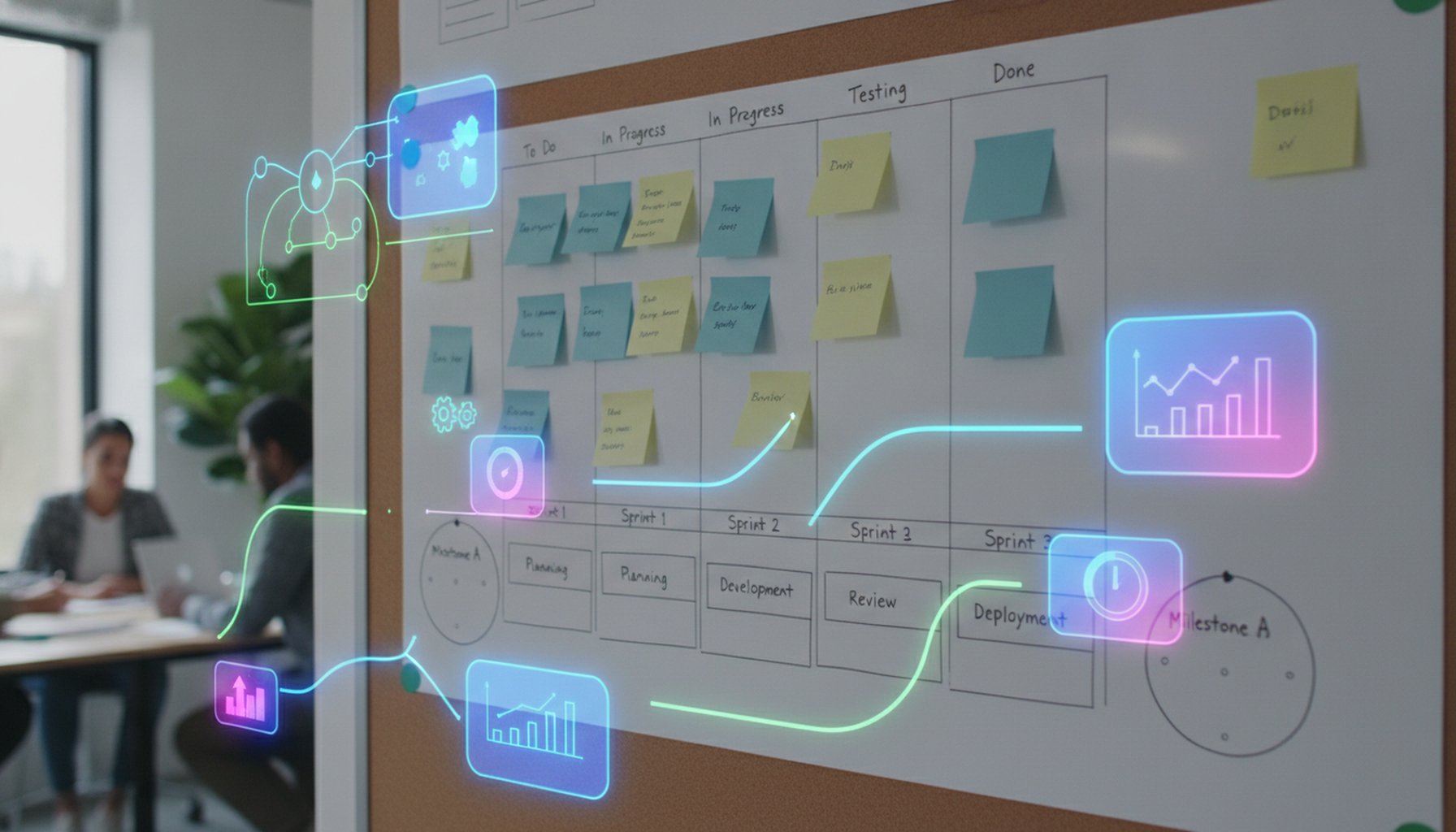
Agile methodology enables rapid iteration. Use weekly sprints with clear deliverables and review points.
Clear success metrics prevent scope drift. Define quantitative KPIs before starting.
Summary: Your roadmap to agentic AI success in Dubai for 2026
The 3-Lens ROI Measurement Framework captures 100% of AI value by measuring Efficiency, Growth, and Strategic dimensions.
Dubai SMEs should budget AED 150K-2M for initial implementation depending on company size, plus 20-30% annually for operations.
The 90-Day Fast-Track Blueprint delivers measurable ROI in 3-6 months with 85% production deployment success rate. Three phases – Discovery (Days 1-30), Deployment (Days 31-60), and Measurement (Days 61-90)—provide structured progression.
Critical success factors determine outcomes: executive sponsorship, cross-functional teams, clear metrics, agile methodology, and experienced implementation partners like Konvergense.
Industry-specific quick wins provide realistic expectations. Real estate lead qualification delivers ROI in 4-6 months. Retail customer service and inventory optimization show results in 3-6 months.
Ready to start your agentic AI transformation?
Frequently Asked Questions
Q: What is agentic AI ROI and how is it different from traditional automation ROI?
Agentic AI ROI measures returns across three dimensions—efficiency (cost/time savings), growth (revenue/customer impact), and strategic value (competitive advantage) – while traditional automation ROI typically only measures efficiency gains, missing 50% of total value.
Traditional automation delivers 15-25% efficiency gains in targeted processes.
Q: How much does AI automation cost for a typical Dubai SME in 2026?
Initial implementation costs range from AED 150K-300K for 50-employee companies, AED 400K-800K for 200-employee companies, and AED 1M-2M for 500-employee companies, plus 20-30% annually for ongoing operations.
The cost breakdown includes: Technology licensing (30% of initial investment), Implementation services (40% of initial investment), Training and change management (15% of initial investment), and Ongoing maintenance (15% of annual costs).
Q: Where does agentic AI deliver the fastest ROI in Dubai businesses?
Customer service automation delivers fastest ROI (3-4 months), followed by lead qualification and CRM automation (4-6 months), document processing (5-7 months), and inventory optimization (6-9 months).
Customer service automation achieves quick wins through high volume, repetitive queries, and 24/7 availability requirements. Typical 60-70% cost reduction with 3-4 month payback.
Q: How do I calculate agentic AI ROI beyond cost savings?
Use the 3-Lens Framework formula: Total ROI = (Efficiency Gains × 40%) + (Growth Impact × 35%) + (Strategic Value × 25%), measuring cost/time savings, revenue/customer improvements, and competitive/innovation advantages respectively.
Efficiency Lens calculation: (Current Process Cost – Automated Process Cost) × Annual Volume = Annual Efficiency Savings.
Growth Lens calculation: (New Revenue Enabled by AI – Previous Revenue) + (CAC Reduction × New Customers) + (Retention Improvement × Customer LTV).
Strategic Lens calculation: Market share movement (valued at revenue impact) + Speed advantage (valued at opportunity cost) + Talent retention (valued at recruitment cost savings).
Talk to Us
Ready to scale your business with a complete digital strategy?
Whether you’re looking to automate with next gen AI, amplify your digital marketing, engage audiences on social media, or build a powerful website – we have expert solutions for your business.
📩 DM us or email mail@konvergense.com for a FREE 30 minute strategy call.
Got questions? Chat on Whatsapp on our website.
Let’s make your business AI powered and future ready.
